Showing posts with label Vera Miles. Show all posts

Wednesday, February 16, 2011

Psycho (1960)

The poster features a large image of a young woman in white underwear. The names of the main actors are featured down the right side of the poster. Smaller images of Anthony Perkins and John Gavin are above the words, written in large print, "Alfred Hitchcock's Psycho".
“I think I must have one of those faces you can't help believing.”

Ever since I first watched Psycho I have always asked myself the question of why this film is so great. After seeing several Hitchcock films such as Rebecca, Notorious, Spellbound, To Catch a Thief, and several others I still could not understand the big deal with Psycho. Then I realized for the most part that like any classic movie to truly appreciate it you need to look at the time period it was made in… and do a little bit of research along the way.
            One of the big questions about Psycho is what makes this film so scary? We look today at what is considered “horror” often with half naked women running around as a crazed guy in a mask runs through the woods chasing them with a blade. Modern horror movies do not grip us psychologically. The bad guys are scary to look but that is about all they are not real and we know that. Psycho is what makes Alfred Hitchcock a genius he made a genuine horror movie that was realistic in its subject. What unnerves us as the viewers so much is knowing that men like Norman Bates exist in the real world and that what happens to Marion Crane could happen to anyone.
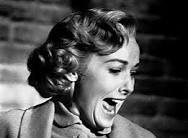
            Paranoia plays a major role in the film. All the main characters go through a state of paranoia. The point when Marion steals the money the characters and the audience are put into a constant state of paranoia. It is a great device and feeling that other “thrillers” severely lack. We get into Marion’s paranoia over the simplest things. As she drives away from Phoenix after she has seen her boss she starts to imagine what everyone must be saying about her. We see her squirming in her seat and fear in her eyes. Marion feels paranoid believing someone besides her coworkers know what she has done and this feeling intensifies when the cop knocks on her car window. Even Norman becomes paranoid when his sinks Marion’s car with her body in it and it stops a bit before it submerges completely. The killer starts to unravel with paranoia when Detective Arbogast and Lila Crane and Sam start coming around asking questions.  We are lead to feel for Marion we want her to get away. Even though Norman is a bad guy we take a deep breath in anxiety hoping the car will go down so he will not be caught. To me the best example of paranoia and fear is when Lila is walking through Norman's mother's room and she catches her reflection in the mirror really quick and scares herself. That was awesome it shows how on edge she was and also broke the tension somewhat. 
            No analysis of Psycho would be complete without talking of the most famous scene in cinematic history: the shower scene. If you can look at this scene deeply it is truly terrifying and genius. Hitchcock played on the fact that we are at our most vulnerable when we are naked alone in the shower. Marion’s privacy and vulnerability has been brutally invaded. This is what shocked and disturbed so many movie goers when the film premiered. Hitchcock also used the idea that what you do not see is scarier than what you do see. We never see the knife plunge into Marion the camera quickly cuts away before we see contact. At the end of the brutal commotion is a great transition from the water flowing down the drain to Marion’s open dead eye. Truffaut asked Hitchcock what attracted him to turn the novel Psycho is based off of into a movie to which the director replied “the suddenness of the murder in the shower, coming as it were, out of the blue. That was about all.”
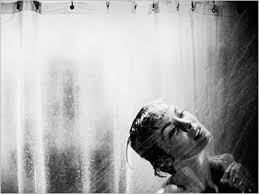
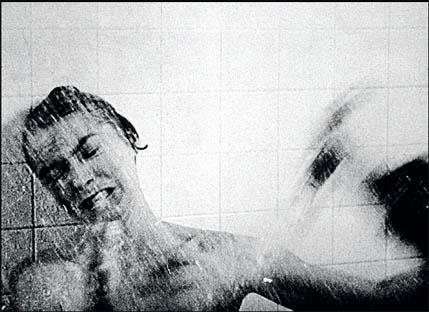
            Another aspect that shocked audience members is the killing of Janet Leigh half way through the film. This was never done before no one was expecting to see her die. This was part of Hitchcock trying to direct the viewers away from what they were so used to doing when they went to movies. As viewers we try to think we are clever and know what will happen next, he was deliberately playing on the fact that he could control the audiences’ thoughts. It is always a shock when something happens that we do not see coming.
            Adding as much of the tension and shock is the incredible score by Bernard Herrmann. The music does not move us it is cold and sterile only played by strings. The music does not allow for any attachment emotionally to the characters which we are not truly meant to. Herrmann made the score a bit twisted; the strings are soft while being played on a high note. Hitchcock did not want a lot of music being played throughout the film, he did not even want music in the shower scene mostly because there is not instrumental music playing all around someone in real life. Once he heard the score for the scene Hitchcock changed his mind.
            Now I do appreciate Psycho more than I used to once I read about it and watched in a film class I took but I will have to disagree that this is Hitchcock’s greatest film. Yes it has left a very long and fantastic legacy on film making but I just do not see it as the director’s best. It is a very good story because it strikes a nerve it is something that could happen it could be real. I will say the film making is the best I have ever seen I will always be amazed by the cinematography and the direction. To me Psycho is just not as good as Hitchcock’s early American films.
            When Hitchcock was interviewed by François Truffaut about Psycho, the director said that he did not care about the subject matter or about the acting what he really cared about was getting to the audience through filmmaking and making them scream. He made this thriller for the audience. Even after its release fifty-one years ago audiences are still left amazed and terrified.

Saturday, December 11, 2010

The Wrong Man

View Image
“This is Alfred Hitchcock speaking. In the past, I have given you many kinds of suspense                pictures. But this time, I would like you to see a different one. The difference lies in the fact that           this is a true story, every word of it. And yet it contains elements that are stranger than all the fiction that has gone into many of the thrillers that I've made before.”- prologue to The Wrong Man

            “ An innocent man has nothing to fear, remember that.”
            Does an innocent man really have nothing to fear? We have heard this kind of line over and over again in crime movies and shows, for the cops they say this to see if the accused squirms or reacts either genuinely or guiltily. Alfred Hitchcock in his film The Wrong Man shows that an innocent man really has many things to fear when accused of a crime he did not commit.
             The Wrong Man is based off the real- life story of Manny Balestrero who is charged with holding up a store. The story was first printed in Life magazine in 1952 by Hubert Brean called “A Case of Identity.”  The story of an innocent man accused of something he did not do is a recurring theme in many of Hitchcock’s movies (Vertigo, North by Northwest, Spellbound). Christopher Emmanuel “Manny” Balestrero (Henry Fonda) plays the double bass in a small orchestra at the Stork Club. He plays late into the night, takes the subway and bus back to his home in Queens. He and his wife Rose (Vera Miles) are like most people, they struggle to make ends meet but they are happy with what they have. Poor Rose is having trouble with her wisdom teeth which will cost $300 to get taken care of (!!!). The next day Manny goes to the insurance company to take out money against Rose’s policy so she can get her teeth taken care of… from here on in Manny’s life is turned upside down.
            That night after Manny comes home from his mother’s house the police are waiting for him outside. The ladies in the insurance office believe that Manny is the one who held up the office the previous month. The police do not even let Manny tell Rose where he is going which makes her worry to no end later on. Witnesses say that Manny is the man who robbed their places of business. He is processed, put in a holding cell, taken to court where his bale is set way too high, and then taken to prison. Fortunately his brother-in-law posts his bale and he is allowed out of prison until the trial.
            After bringing Manny back home, Rose phones a lawyer named O’Connor. They see the lawyer the following. Rose is very optimistic and does all the talking while Manny is silent. O’Connor will take the case but he warns the Balestreros that he has never done a criminal case. During the meeting we find out that on the night of one of the crimes the Balestreros were on vacation. They go up to the place where they stayed and talk to the couple who run the motel. Manny remembers playing cards with some men. When they get back to the City, Manny and Rose try to track down these men for witnesses but they have no luck, two of the men are dead and one cannot be found.
            Rose is no longer optimistic about things. She’s worrying that Manny will be sent to jail and about money. She and Manny sit in O’Connor’s office and she just stares off into space. O’Connor notices something is wrong and suggests she gets up. When Manny gets home from work one night, Rose is still awake; she hasn’t been able to sleep for the past few nights. Manny now sees that something is definitely wrong with his wife. At one point she takes a brush and hits Manny over the head with it and cracks a mirror. Manny takes Rose to a specialist. He tells Manny that Rose is feeling guilty that all this has happened because of her and they are drowning in debt because she feels she was not good with money. The specialist suggests Rose goes into a home for a while to straighten out her mind.
            Manny’s trial is not going well. Two women identify Manny as the robber and a juror stands up asking why they have to listen to all the testimony anymore which causes a mistrial. At home while getting ready for work one night, Manny is basically at wits end with this whole trial. His life has been turned upside down and he wishes he had just been found guilty since it would be easier for him to move on. His mother tells him to pray but he just says it doesn’t work it’s luck he needs. When he walks into his bedroom he looks at a picture of Jesus on the wall and begins to pray. As he prays his face fades and we see a man walking towards the camera. The man’s face fits into Manny’s; it is the man who has been causing the Balestreros all their troubles and whom Manny has been mistaken for.
            The man walks into a deli and asks for some ham. As the woman goes to get the ham he walks behind the counter. He messes with the wrong woman!! The woman takes a knife and holds it out ready for him if comes and attacks. She stomps the floor as an alert and her husband comes up and attacks the robber. The police come and take him in.
            As Manny is working an employee tells him that the police need him to come down to the station and he leaves his double-bass on stage. At the station O’Connor tells Manny they got the guy and the innocent man and guilty man come face to face. Manny, not thinking of himself says to the robber “do you know what you have done to my wife?” The women who accused Manny in court have now positively identified the real the man; they cannot look Manny in the eye as they walk out because of embarrassment.
            The first thing Manny does the next day is go to Rose at the home she is staying at. He tells her everything will be alright but she’s not in her right frame of mind she is still out of it. This crushes Manny to no end.
            The film ends with a title card saying that two years later Rose was completely cured and the family is now living in Florida.
            The Wrong Man is not considered to be one of Hitchcock’s best films. When you watch a Hitchcock film you expect there to be this fantastic fictional suspense/mystery/thriller with a love story thrown in. The Wrong Man is a true story that cannot be fictionalized which makes this film underrated. It is a shame that this film considered underrated, I personally think, while it is not the best story, it is one of Hitchcock’s best directed films. As I watched this film I was amazed by the camera angles and how much they made us feel for Henry Fonda’s character. When Manny is in the holding cell Hitchcock pans the room as if we were looking through Manny’s eyes and he does the same thing in the courtroom and when Manny is being transferred to the prison. In the courtroom scene we see that Manny’s confidence is shaking as he looks as the jury not paying attention and talking, one of the lawyers that is defending him is drawing on a notebook and not listening at all, and his sister is putting on lipstick. Hitchcock explained to Francoise Truffaut about the prison transfer:
            “During the journey between the station house and the prison, there are different men guarding him, but since he’s ashamed, he keeps his head down, staring at his shoes, so we never show the guards… In the same way, during the whole trip, we only show theguards’ feet, their lower legs, the floor, and the bottom parts of the door.”
We see what Manny is nervously looking at as he walks past other prisoners. We can genuinely feel that Manny is sad and nervous and scared and feels that he does not belong with these real criminals. Hitchcock filmed the emotions of Montgomery Cliff’s character the same way three years previously in I Confess.
            Going for broke on realism, Hitchcock actually filmed The Wrong Man in New York City in the same neighborhoods the events really took place. He even used the actual home where Rose goes and had the actual doctors playing themselves. Vera Miles and Henry Fonda spent some time with the real Balestreros before shooting began. The real guilty man was caught by the woman who owned the deli but instead of holding the knife away from the man she had the knife against his stomach which made the man so scared that he did not move and the husband was easily able to keep the man down until the police came. Like in the film the man said “Let me go. My wife and kids are waiting for me.” Hitchcock told Truffaut that this line would never be written into a movie for how ridiculous it sounds but it just worked.
            One problem Hitchcock finds as a weakness in the film is the interruptions of Manny’s story to show how Rose is gradually losing her mind. I do not find these interruptions as a weakness. Yes they are interruptions they come at not the greatest moments for the flow of the story sometimes but I feel they are important. Showing Rose losing her mind over this is important; this is just one of the things that Manny has to fear. Vera Miles was excellent as Rose. The scene in the lawyer’s office when she is starting to slip was done so well; you can actually relate and understand her feelings of despair and hopelessness and of feeling stuck. She sits in the chair feeling numb. Hitchcock wanted to make Vera Miles his next Grace Kelly and you can tell by this film she could have been his next great  muse; her acting was fantastic (she was only 27 when she made this).
            The Wrong Man, while it may be underrated, is still a very good Hitchcock film. It is an unconventional Hitchcock movie which is probably why many do not like it; but from it being different from all his other films that is what makes The Wrong Man so good. The film is chilling because it is so real. We can relate to the working man and the problems of having debts, we can relate to the hopelessness, the nervousness, the sadness, and the frustrations of the characters. Truffaut points out the Hitchcock that in the hands of a lesser director this movie would not have worked out at all. But of course Hitchcock being the Master of Suspense and the greatest director of all time he made The Wrong Man work, he made this true story suspenseful and frightening.